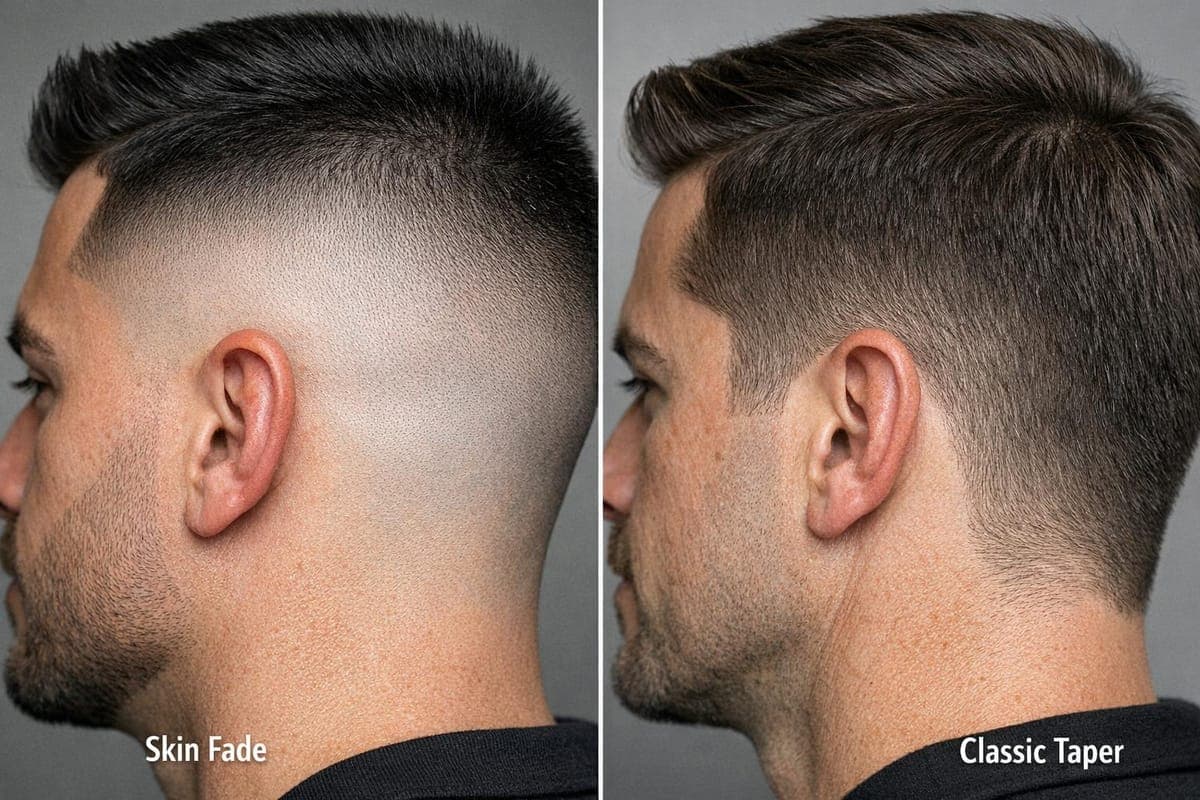
High fade and mid fade are two of the most popular barbershop styles — and the difference between them significantly affects how the cut looks and suits your face. Choosing the wrong fade height for your face shape is one of the most common haircut mistakes men make. Here's how to get it right.
Skip the guesswork — start with a free face-shape, hairline, and density analysis before you choose a barber brief.
Start my free analysisWhat is a high fade?
Works well for
- ✓Square and oval face shapes
- ✓Men wanting a bold, modern look
- ✓Thinning hair and receding hairlines
Avoid if
- ✗Round faces (emphasises width)
- ✗Very formal or conservative professional environments
A high fade is bold, modern, and creates strong vertical lines. It suits men who want a defined, urban look.
What is a mid fade?
A mid fade is the most versatile choice. It suits virtually all face shapes, works in most environments, and is the default recommendation for men who are unsure what to ask for.
Not sure if this cut will suit you?
Upload once to get a free read on your face shape, hairline, and density before booking the barber.
Free: your analysis plus a personalised preview with the haircut teased.
Start my free analysisKey differences: high fade vs mid fade
High fade — near the temples.
Mid fade — mid-point of sides, level with top of ear.
Visual impact:
High fade — dramatic, bold, high contrast.
Mid fade — clear but balanced contrast.
Face shape effect:
High fade — creates strong vertical lines, can emphasise jaw width.
Mid fade — suits all face shapes.
Best for thinning hair:
High fade — stronger redirection of attention from the hairline.
Mid fade — also effective, slightly more subtle.
Maintenance:
Both need refresh every 3–4 weeks.
Which is better for thinning hair and receding hairlines?
What to say to your barber
“For a high fade: High skin fade — I want the fade to start high, near the temples. Keep [X] on top with texture. For a mid fade: Mid skin fade — start the fade at the mid-point of the sides, level with the ear. Keep [X] on top.”
Which suits your face shape?
Square: Both work. A high fade can emphasise the jaw — if yours is very wide, a mid fade may be more flattering.
Round: Mid fade is safer. A high fade can create a very wide silhouette at the sides before the fade, emphasising roundness. A mid fade is a better choice.
Oblong: Mid or low fade. A high fade on an oblong face can make the face look even longer by reducing width low down.
Heart: Mid or low fade. A high fade can emphasise the wide upper face.
Frequently asked questions
- Which is more popular — high fade or mid fade?
- Mid fade is more popular overall. It's the safer, more versatile choice. High fades are popular in urban barbershop aesthetics and with men who want a bold look.
- Can I switch between a high and mid fade at my next cut?
- Yes — at every cut, the barber sets the fade height fresh. Just specify which you want at each visit.
- Does a high fade grow out faster than a mid fade?
- A high fade grows out slightly faster because there's more faded area to fill in. Both need a refresh at around 3–4 weeks for a skin fade.
Free analysis · 30 seconds · No account needed
Don't gamble on your next haircut
You only get a haircut every few months. Make sure it's the right one.
Upload a photo for a free read on your hairline, face shape and density — plus a personalised preview that proves it is your photo while keeping the haircut blurred. Unlock our exact pick clearly, then try another style or hair colour before you sit in the barber chair.
Start my free analysisOriginal photo deleted within 7 days · No spam · No account required