
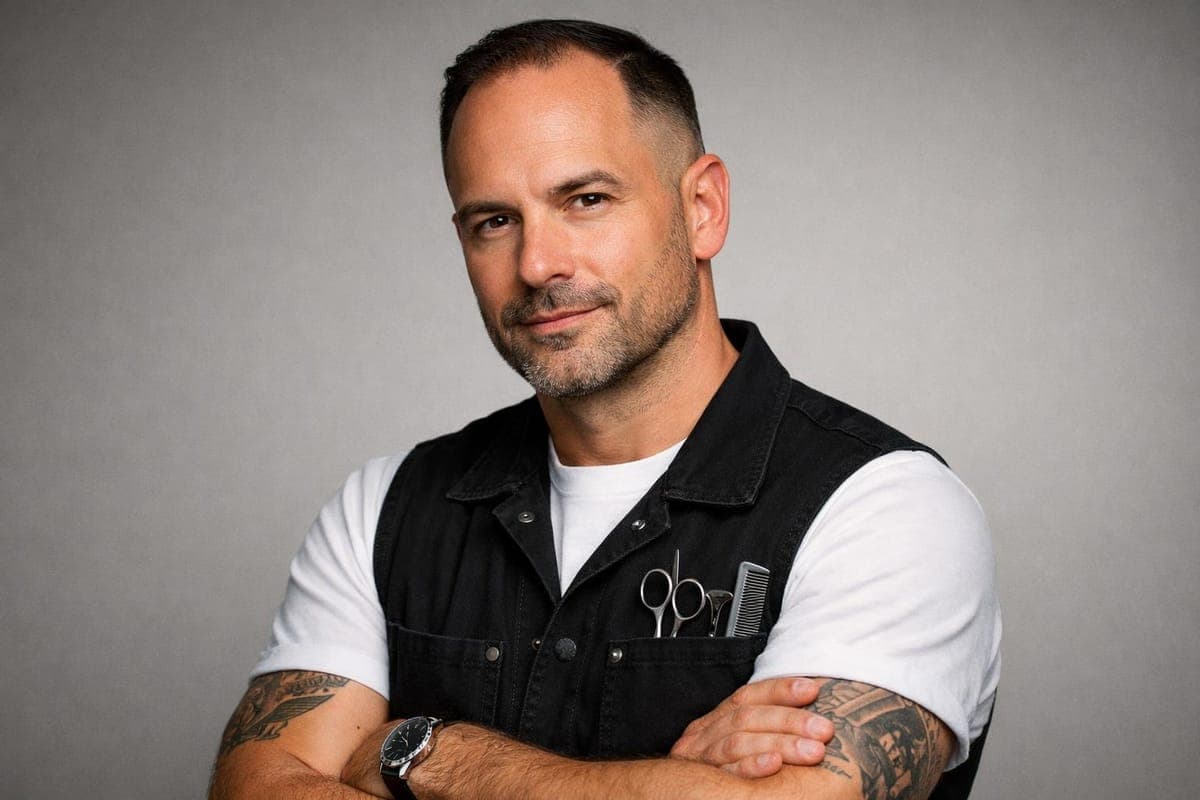
The Norwood scale is the standard map of male pattern baldness, with seven stages from a full juvenile hairline to extensive loss. Knowing your stage is only useful if you know what to do with it. The right haircut changes at every step, and a common mistake is wearing a cut built for an earlier stage than the one you're actually at. This hub maps each Norwood stage to the cuts that work, links to the detailed guide for your stage, and gives you the one principle that holds across all of them. Find where you are, then go deeper.
Find your stage first
Not sure which Norwood stage you are?
Upload a photo and let the AI check the pattern before you choose a cut. Pick the closest concern below to start your analysis.
What this helps you decide
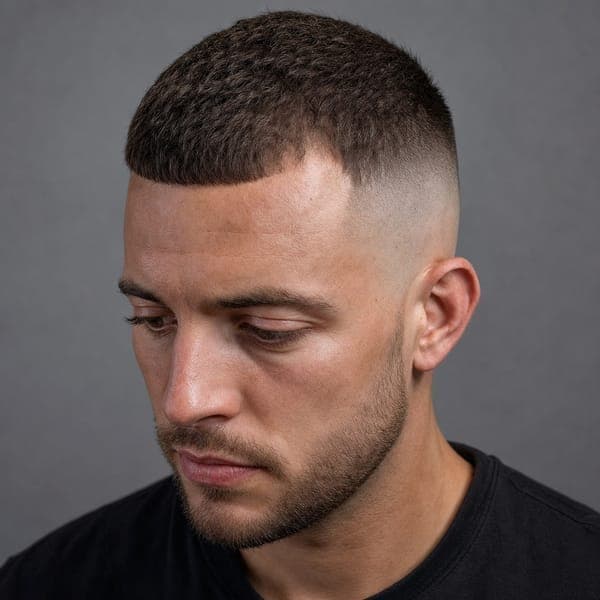
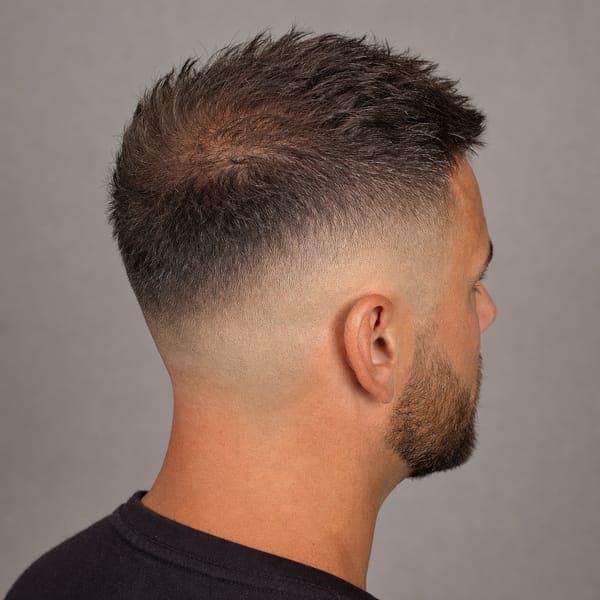
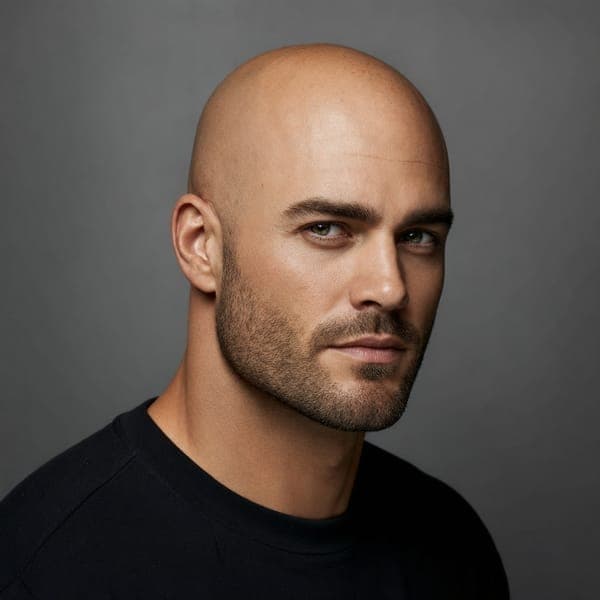
See a few realistic directions before you upload your own photo.
The one principle behind every Norwood haircut
The progression makes sense once you see it. Early stages let you keep texture and length because there's little contrast to manage. Later stages call for buzzes and shaves because removing length removes the contrast entirely.
Norwood stages at a glance
| Stage | What it looks like | Best cuts | Detailed guide |
|---|---|---|---|
| Norwood 1 | Full juvenile hairline, no recession | Anything: texture, length and fades all work | Norwood 1 guide |
| Norwood 2 | Slight temple recession | Textured crop, French crop, crew cut, fades | Norwood 2 guide |
| Norwood 3 | Clear M/V-shaped recession | Buzz, textured crop + high fade, Caesar | Norwood 3 guide |
| Norwood 4 | Deep recession + crown thinning | Buzz at Grade 1 to 2, high skin fade, tight Caesar | Norwood 4 guide |
| Norwood 5 | Front and crown merging, horseshoe forming | Buzz at Grade 1, shaved head, bald fade | Norwood 5 guide |
| Norwood 6 | Bridge gone, broad bald area | Shaved head or Grade 1 buzz | Norwood 6 & 7 guide |
| Norwood 7 | Only a horseshoe band remains | Shaved head, beard pairing | Norwood 6 & 7 guide |
Not sure which stage you're at? The detailed guides describe each one in plain terms. Start with the closest match.
Not sure if this cut will suit you?
Upload once to get a free read on your face shape, hairline, and density before booking the barber.
Free: your analysis plus a personalised preview with the haircut teased.
Start my free analysisNorwood 1 to 2: keep your options open
At Norwood 2 the recession is minor and easy to work with. Textured crops, French crops, crew cuts and clean fades all look sharp, and the key is to avoid long swept-back styles that emphasise the temples. This is the easiest stage to look good in. The full breakdown is in the Norwood 2 haircuts guide.
Norwood 3: the first real turning point
The cuts that work here frame the recession rather than hiding it. The Norwood 3 haircuts guide covers every option, what to avoid, and when to consider going shorter.
Norwood 4: when concealing stops working
This is the stage where committing early pays off most. The full guide on what works, what to avoid, and when to make the switch is in the Norwood 4 haircuts guide.
Norwood 5 to 7: commit, and look better for it
This isn't a downgrade. A confident shaved head, especially with a well-groomed beard, can be a man's best look. The detailed advice for Norwood 5 is in the Norwood 5 haircuts guide. At Norwood 6 and 7 the same logic applies more firmly. The Norwood 6 & 7 haircuts guide covers when to shave, how to do it right, and how a beard completes the look.
How to find your Norwood stage honestly
Second, when you're between two stages, plan for the later one. A cut built for the stage you're approaching holds up better than one built for the stage you're leaving. Going slightly shorter than strictly necessary costs very little, while clinging to length gives you a cut that visibly fails within weeks.
If you'd rather not guess, an AI photo analysis can estimate your stage, crown density and face shape and recommend specific cuts. See the tool below.
Frequently asked questions
- What is the Norwood scale?
- The Norwood scale, also called the Hamilton-Norwood scale, is the standard classification of male pattern baldness. It runs from stage 1, a full hairline, to stage 7, extensive loss with only a horseshoe band remaining. It describes the pattern and progression of hair loss and is a useful starting point for choosing a haircut.
- How do I know my Norwood stage?
- Compare your hairline and crown to the stage descriptions. Slight temple recession is Norwood 2, a clear M-shape is Norwood 3, deep recession plus crown thinning is Norwood 4, and a merging front and crown with a horseshoe forming is Norwood 5. Judge from photos taken by someone else, including from above and behind, since mirrors hide the crown.
- What is the best haircut for each Norwood stage?
- At Norwood 2, use a textured crop, French crop or crew cut. At Norwood 3, use a buzz, a textured crop with a high fade, or a Caesar. At Norwood 4, use a buzz at Grade 1 to 2, a high skin fade, or a shaved head. At Norwood 5 and beyond, use a shaved head, a Grade 1 buzz or a bald fade. The principle across all stages is to reduce the contrast between thinning and full areas, going shorter as loss advances.
- At what Norwood stage should I shave my head?
- There's no fixed rule, but a shaved head becomes the clearly best option around Norwood 4 to 5, once the crown is thinning and the front and crown begin to merge. Many men shave earlier by choice for the low maintenance and confident look. If your barber is struggling to blend the cut or the crown shows in photos, it's time to consider it.
- Does the Norwood scale predict how bald I'll get?
- Not reliably. The Norwood scale describes your current stage and the typical pattern of progression, but the rate and final extent vary a lot between individuals. Many men stabilise at an early stage for years, and others progress steadily. Treatments such as minoxidil and finasteride can slow or pause progression, but the right haircut looks good at whatever stage you're at.
Free analysis · 30 seconds · No account needed
Don't gamble on your next haircut
You only get a haircut every few months. Make sure it's the right one.
Upload a photo for a free read on your hairline, face shape and density — plus a personalised preview that proves it is your photo while keeping the haircut blurred. Unlock our exact pick clearly, then try another style or hair colour before you sit in the barber chair.
Start my free analysisOriginal photo deleted within 7 days · No spam · No account required